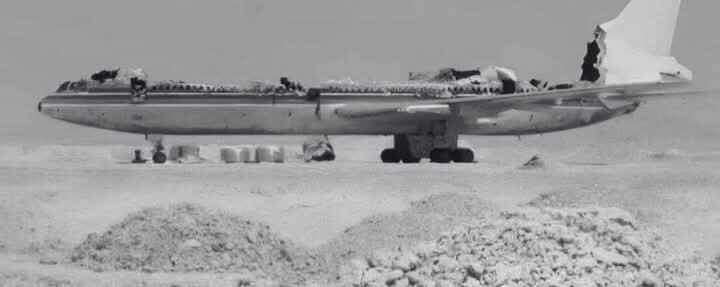
The Perfect Landing That Became a Silent Grave
The captain landed the burning plane perfectly.
All 301 people were alive when the wheels touched the runway.
Twenty-three minutes later, they were all dead.
August 19, 1980. Riyadh, Saudi Arabia.
Saudi Arabian Airlines Flight 163 lifted off at 6:08 PM, bound for Jeddah. It was a short domestic flight, the kind flown thousands of times without incident. On board were 287 passengers and 14 crew members—families returning home, business travelers on tight schedules, and pilgrims beginning a sacred journey toward Mecca. Nothing about the evening felt unusual. It was supposed to be routine.
Seven minutes after takeoff, that routine shattered.
A warning light illuminated in the cockpit: fire in the aft cargo hold.
Captain Mohammad Ali Khowyter, a seasoned and respected pilot, reacted immediately. Emergency procedures were initiated without hesitation. He declared an emergency and informed air traffic control that the aircraft would return to Riyadh at once.
Inside the cabin, the danger announced itself quietly at first. A smell—sharp, chemical, unmistakably wrong—crept through the aircraft. Smoke began seeping up through the floor and along the walls. What started as a haze quickly thickened into something far more serious.
Flight attendants moved through the aisles, doing everything they could to keep passengers calm. They instructed them to stay seated, to place wet towels over their faces, to breathe as carefully as possible. Reassurance echoed through the cabin: We are returning to Riyadh.
But the smoke was spreading fast.
In the cockpit, Captain Khowyter maintained full control of the massive Lockheed L-1011 TriStar. Despite the growing emergency behind him, he flew with precision and discipline, following procedures exactly as trained. Communication with air traffic control remained steady. Every checklist was addressed.
At 6:36 PM, just 28 minutes after takeoff, the aircraft touched down on Riyadh’s runway.
The landing was flawless. Smooth. Controlled. Professional.
Fire trucks were already in position. Ambulances waited nearby. The aircraft was intact. Everyone on board was still alive.
The worst was supposed to be over.
Then, everything went wrong.
Instead of stopping immediately on the runway, the aircraft continued moving. The captain taxied it off the active runway and onto a taxiway. The engines remained running.
Inside the cabin, the situation was deteriorating rapidly. Smoke had filled the enclosed space, turning the aircraft into a sealed chamber of toxic air. Breathing became agonizing. Passengers coughed violently, gasped for oxygen, and began losing consciousness. Flight attendants struggled to remain at their posts as the smoke overwhelmed them.
Outside, fire trucks followed the aircraft—but they could not approach. The engines were still running, and the jet blast made it too dangerous to come close. Firefighters waited, watching precious seconds turn into minutes.
The plane finally came to a stop on the taxiway.
The engines kept running.
For reasons investigators would later analyze and debate for years, evacuation did not begin. The doors stayed closed. No slides were deployed. No one exited the aircraft.
Inside, the smoke became lethal.
One by one, passengers lost consciousness in their seats. Some were found still holding wet towels to their faces. Flight attendants collapsed where they stood, trying to do their jobs until the very end. In the cockpit, the crew remained at their stations.
Twenty-three minutes after landing, the engines were finally shut down.
Firefighters rushed the aircraft. Doors were forced open.
What they found was silence.
The cabin was so full of smoke that visibility was almost zero. And inside were 301 people—every single passenger and crew member—dead.
Not from the fire itself.
Not from a crash.
But from smoke inhalation and asphyxiation.
The investigation revealed a devastating chain of events. The fire had likely started in the aft cargo hold, possibly caused by butane stoves improperly packed in passenger luggage. As it burned, it produced thick, toxic smoke that spread throughout the aircraft.
The captain had done what pilots train their entire careers to do: he brought a burning aircraft safely back to the ground. But the minutes after landing proved fatal. The decision to taxi instead of stopping immediately. The delay in shutting down the engines. The failure to evacuate right away.
By the time the doors were opened, everyone who had survived the flight and the landing was already dead.
That is what makes Saudia Flight 163 one of the most haunting disasters in aviation history.
It wasn’t a crash.
It wasn’t an explosion.
It was a successful emergency landing followed by a failed evacuation.
Everyone lived through the most dangerous part—only to die on the ground, surrounded by rescue crews who were just minutes too late.
The tragedy forced aviation to confront painful questions:
Why wasn’t the aircraft evacuated immediately?
Why did it continue taxiing?
Why were the engines left running?
Could every life on board have been saved if evacuation had begun the moment the plane stopped?
The answers were complex. Extreme stress. Heavy smoke in the cockpit. Possible impairment of the crew themselves. Emergency procedures at the time did not clearly mandate immediate evacuation after landing.
But the conclusion was undeniable: the delay killed everyone.
Because of Saudia Flight 163, aviation safety changed forever.
New rules were created and enforced:
Immediate evacuation after any emergency landing involving fire or smoke
No taxiing to “safer” locations
Engines off immediately
Doors open, slides deployed, evacuate now
Improved cargo fire detection and suppression systems
Stricter controls on hazardous materials in luggage
A new mindset took hold:
If you can land, you can evacuate. Do it immediately.
Today, pilots and flight attendants are trained relentlessly on this lesson. There is no waiting. No hesitation. No delay for convenience or positioning.
Those procedures exist because 301 people paid the ultimate price.
Think about their final moments—the relief when the wheels touched the runway, believing they had survived. Then the confusion. The unanswered question: Why aren’t we getting out? The smoke growing thicker. The air disappearing. Consciousness fading.
All while the aircraft sat safely on the ground.
Saudia Flight 163 is remembered not for how it crashed—but for how it landed.
Perfectly.
And how, in the silence that followed, everyone died anyway.
That is its legacy: a perfect landing, a failed evacuation, and a tragedy that reshaped aviation safety forever.