.article-container {
max-width: 900px;
margin: 28px auto;
font-family: -apple-system, BlinkMacSystemFont, “Segoe UI”, Roboto, “Helvetica Neue”, Arial;
line-height: 1.7;
color: #222;
padding: 18px;
}
.article-title {
font-size: 2rem;
margin: 0 0 12px 0;
line-height: 1.15;
}
.article-sub {
font-size: 0.95rem;
color: #555;
margin-bottom: 18px;
}
.article-body h2 {
margin-top: 28px;
font-size: 1.4rem;
color: #111;
}
.article-body p {
font-size: 1rem;
margin-bottom: 16px;
text-align: justify;
}
@media (max-width:600px){
.article-container { padding: 12px; }
.article-title { font-size: 1.5rem; }
}
The Treasure of the Salt Mines
An extended narrative about the Merkers discovery, its shocking inventory, the soldiers who found it, and the echoes it left in history.
Whispers Beneath the Earth
In the spring of 1945, as the war in Europe drew toward its violent conclusion, Allied troops pushed deeper into the heart of Germany. Villages lay in ruins, cities smoldered, and whispers of hidden treasures circulated among locals. One rumor spoke of something extraordinary concealed beneath the quiet town of Merkers: a labyrinth of salt mines where the Nazis had hidden more than just minerals. Soldiers who heard the tale were skeptical, for they had already seen countless vaults and warehouses filled with looted goods. Yet, something in the hushed tones of the villagers convinced them that this mine was different.
The Descent
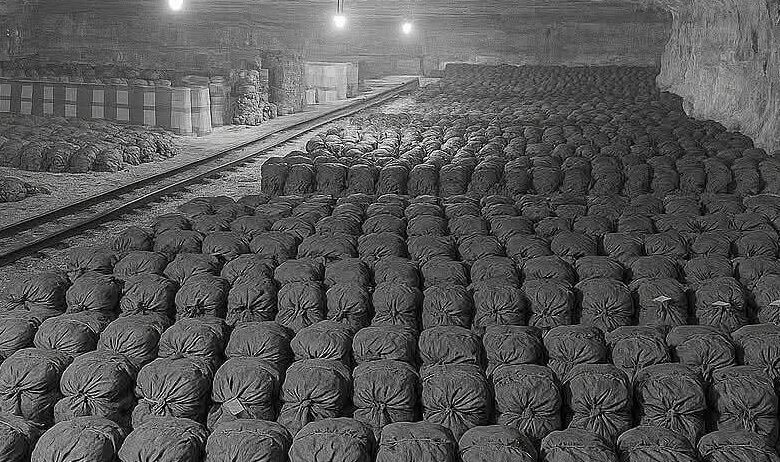
The Merkers mine entrance was unassuming, little more than an industrial shaft leading into darkness. But as soldiers descended with their lanterns and flashlights, the stale air of centuries gave way to something uncanny. The tunnels stretched endlessly, and the deeper they went, the more the walls sparkled with crystals of salt. Then, at the end of one passage, they stumbled upon massive steel doors. Armed guards forced them open, and the beams of light fell upon a sight that silenced every man present: stacks of bullion, bags, and boxes stretching beyond imagination.
The Inventory of Empire
When they began to catalog what they had found, the enormity of the hoard became clear. There were 8,198 bars of gold bullion, stacked neatly as if awaiting the construction of a golden fortress. Fifty-five crates sealed with military precision contained more bullion, untouched since their packing. Bags bulged with gold coins and jewelry—rings, brooches, and heirlooms torn from their rightful owners. More than 1,300 sacks of gold currency overflowed with Reichsmarks, British pounds, and French francs. American twenty-dollar gold pieces filled 711 more sacks. Silver coins of every denomination clinked within hundreds of additional bags, and nine sacks held rare coins so valuable that collectors today can only dream of them.
Alongside this glittering wealth were 2,380 bags and 1,300 boxes of Reichsmarks in paper form, totaling an astronomical value of 2.76 billion. There were 20 silver bars, 40 bags of additional silver, 63 boxes of silver plate once used by noble families, and a single small bag containing six platinum bars—rarities of near-mythical worth. One hundred and ten miscellaneous bags held treasures from across the continent. It was as if the plunder of all Europe had been compressed into these caverns, waiting in the dark.
Soldiers’ Reactions
The men who stood among these riches were not awestruck with greed but stunned into uneasy silence. Some stared at the bars, trying to comprehend the sheer volume. Others fingered the bags of coins, realizing these had once passed through the hands of ordinary families before being stripped away by war and cruelty. A few whispered prayers. The weight of what they had uncovered was not measured in gold, but in lives—the silent testimony of millions who had lost everything.
The commanding officers quickly forbade looting and treated the site with the gravity of a crime scene. The soldiers became guardians rather than beneficiaries, their rifles slung across shoulders as they stood watch over the fortune of nations.
The Aftermath
News of the discovery spread rapidly through Allied command. The treasure was not simply wealth—it was evidence. Proof that the Nazi regime had not only conquered territories but had systematically drained them of cultural and financial life. The salt mine hoard became a symbol of organized plunder on a continental scale.
In the months that followed, much of the treasure was transferred under military escort and eventually used in restitution efforts, though many victims never saw their possessions again. Historians, investigators, and governments pored over the records to trace what could be returned, but the sheer complexity of the loot made justice incomplete. Still, the exposure of the hoard weakened any myth of Nazi glory, revealing instead a machinery of theft and greed.
A Cautionary Monument
Today, the Merkers salt mine treasure is remembered not as a bounty but as a warning. Its glittering bars and countless bags remind us of the cost of unchecked ambition and cruelty. Wealth seized through suffering cannot sustain an empire, for it carries the burden of sorrow. The true heirs of the discovery are not treasure hunters but the soldiers who revealed it, the historians who preserved its story, and the nations that vowed never to forget.
In the end, the salt mines speak less of gold and silver than of humanity itself. Their cavernous silence tells us that memory is richer than greed, justice stronger than tyranny, and that history, however painful, must always be uncovered—just as those soldiers uncovered the hidden fortune in the depths of Merkers.