I Put a Brick in My Toilet Tank to Save Water Like They Did in the 70s — Here’s What Happened After 60 Days
In an effort to cut down on water usage and lower my utility bill, I decided to try an old-school conservation trick that was popular decades ago: placing a brick inside the toilet tank. The idea is simple—by displacing water, the tank fills with less, and each flush uses less water overall.
It sounded harmless enough. After all, people in the 1970s and 1980s reportedly used bricks, stones, and even bottles filled with sand to reduce water consumption before modern low-flow toilets became standard. Curious to see if this retro hack still works today, I decided to run a 60-day experiment in my own bathroom.
The Setup
I chose a standard ceramic brick, wrapped it tightly in plastic to prevent it from crumbling or releasing debris, and placed it carefully inside the toilet tank. I made sure it didn’t interfere with the flushing mechanism or moving parts.
At first, everything seemed fine. The toilet flushed normally, and I immediately noticed that the tank filled with slightly less water. It looked like a small but promising step toward saving water.
Week 1–2: No Visible Problems
During the first couple of weeks, nothing unusual happened. The flush still worked, though it felt slightly weaker than before. I didn’t think much of it. If anything, I felt satisfied knowing I was using less water every time I flushed.
However, I also started noticing that sometimes I needed a second flush for solid waste—something that hadn’t been necessary before.
Week 3–4: The First Warning Signs
By the end of the first month, the downsides became more obvious.
The flush power continued to weaken
The tank seemed to refill faster but with less pressure
Occasionally, residue would remain in the bowl after a single flush
At this point, I realized the brick was doing exactly what it was supposed to do—displace water—but my modern toilet wasn’t designed for such a modification.
Week 5–6: Minor Frustrations Build Up
As the weeks went on, the inconvenience became more noticeable:
Double flushing became more frequent
Cleaning the bowl was needed more often
The flushing mechanism occasionally sounded strained
It wasn’t breaking anything, but it definitely wasn’t functioning at peak efficiency anymore. Any water savings I gained were being offset by extra flushes.
Day 60: The Final Verdict
After 60 days, I removed the brick and evaluated the results.
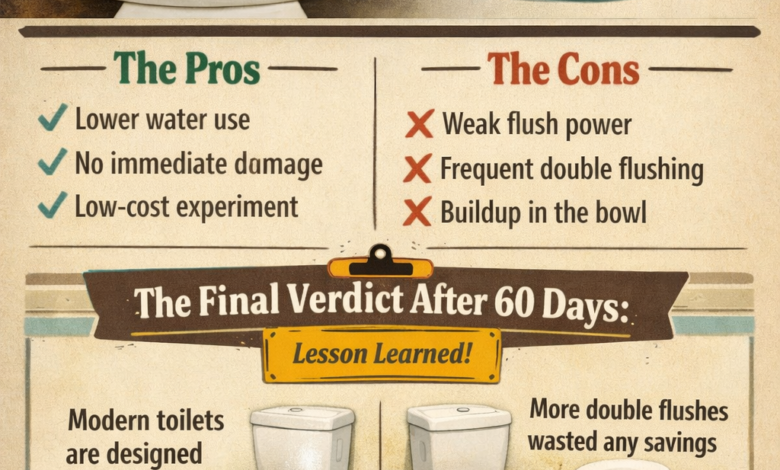
What worked:
Water usage per flush was technically reduced
No immediate damage occurred to the toilet
It was a simple, low-cost experiment
What didn’t work:
Reduced flushing power led to inefficiency
More frequent double flushing likely canceled out savings
Modern toilets are already engineered for water efficiency
The Bigger Lesson
While the brick-in-the-tank trick made sense decades ago, it doesn’t translate well to modern plumbing systems. Today’s toilets are carefully designed to balance water efficiency and flushing performance. Disrupting that balance—even slightly—can reduce effectiveness and sometimes even waste more water than it saves.
If your goal is to save water today, there are far better options:
Installing a certified low-flow or dual-flush toilet
Using adjustable flush settings if your model allows it
Fixing leaks (which often waste far more water than flushing habits)
Final Thoughts
The brick experiment was interesting, nostalgic, and slightly educational—but ultimately outdated. It showed me that not all “old hacks” are still effective in modern homes.
Sometimes progress really does mean improvement.
And in this case, the 70s solution belongs in the past.