Glimpses of Early Portland: Congress Square in 1907
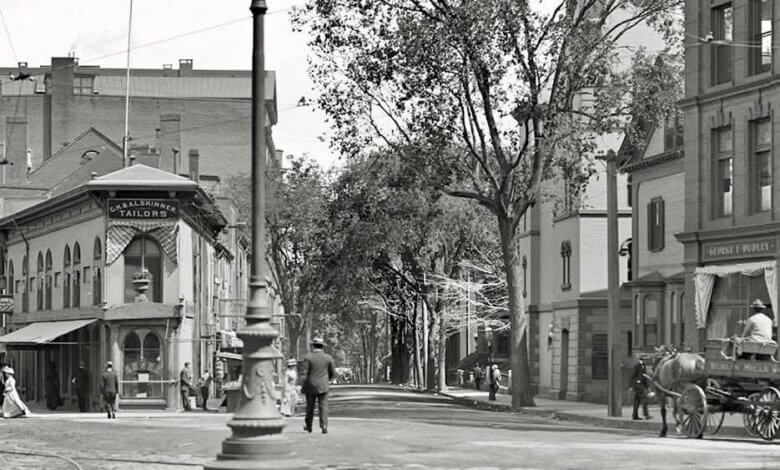
In 1907, what we now call Congress Square did not officially exist by that name. The buildings seen in the photo from that year—including the Free Street Baptist Church, the Christian Women’s Temperance Building, and the Y.M.C.A., later known as the Libby Building—all had Free Street addresses: 142–146, 150, and 156 respectively.
One fascinating detail is the triangular building on the left. At the time, it was only two stories tall and was not yet home to the well-known H. H. Hay Drug Store. Instead, the building hosted several businesses: the Williamson Drug Store, C.H. and A.L. Skinner tailors—whose ornamental bow-tie sign decorated the second-floor window—and a charmingly unique combination business owned by Mr. and Mrs. Fred Flint. He sold candy, and she ran a millinery shop side by side. It’s easy to picture a young couple visiting—he choosing sweets for his sweetheart, and she selecting a new hat.
The Y.M.C.A. building also holds intriguing secrets. A building directory visible beside the entrance reveals that it wasn’t occupied solely by the Y.M.C.A., as one might assume. Research shows that the five-story structure also housed numerous dentists, the Bible Society of Maine, several music teachers (including the Portland International School of Music), and the Federation of Churches along with its Women’s Auxiliary. This raises questions: where exactly did the Y.M.C.A. operate within the building, and what facilities did they offer before moving to their Forest Avenue location in 1927? And was there really a swimming pool, as locals later claimed—even when piano lessons were held on the fifth floor in the late 1960s?
In 1926, the Portland Chamber of Commerce purchased the Free Street Baptist Church, which had originally been constructed in 1830 as a theater. They commissioned renowned architects John Calvin Stevens and his son John Howard Stevens to restore the building to its original design. The Chamber later occupied it until it became the Children’s Museum of Maine, and eventually, the Portland Museum of Art acquired it—only to demolish it, erasing yet another piece of Portland’s history.
Finally, the ground floor of the Y.M.C.A. was a hub of small businesses. George F. Dudley, a barber, had his shop on the building’s eastern corner. Nearby, M. Kaufman, owned by Morris Kaufman, specialized as a Ladies’ Tailor. E. S. Norton Shoes, run by Eugene S. Norton & Co., sold Heywood Specialty Shoes—premium footwear made by the Heywood Boot and Shoe Company of Worcester, Massachusetts, a manufacturer dating back to 1864 known for crafting fine men’s boots and the famous Heywood Special Shoe for Women.
This snapshot of Congress Square in 1907 captures not just a moment in time but the lively fabric of a growing city—one filled with craftsmanship, community, and a history that continues to echo through Portland’s streets today.